
Breadcrumb
Beyond The Alert: Your Infrastructure's Monday Morning Memory
There's a version of infrastructure monitoring that requires you to remember to check. You log in, look at the dashboard, get the current state of your endpoints, and form a picture of how things are going based on whatever you happen to look at today. That version of monitoring has a fundamental problem: it only works when you remember to do it. And the people who most need to understand how their infrastructure is performing are usually the last ones who remember to log into a monitoring dashboard. The infrastructure weekly digest was built to solve exactly that problem.
What The Infrastructure Weekly Digest Actually Is
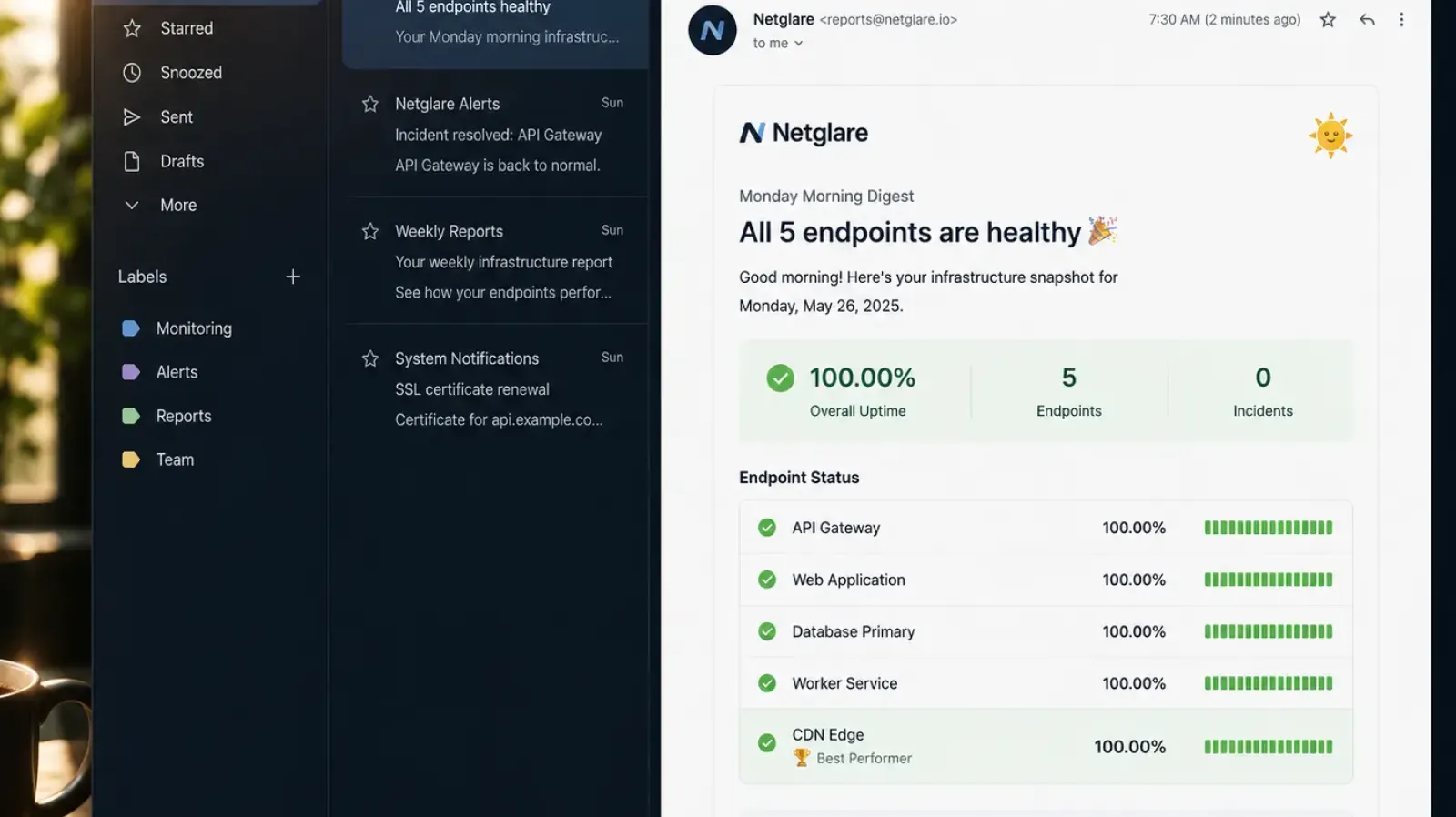
Every Monday at 08:00 EAT, Netglare sends every verified user on your account a weekly infrastructure health report. No login required, no dashboard to navigate, just a clean email showing the shape of your week: overall weighted uptime across all your endpoints, per-endpoint performance sorted worst-first so you know immediately where to focus, p95 response times, total incident count, average time to resolution, and a status classification for every endpoint you're monitoring.
If one of your endpoints had a perfect week, 100% uptime with zero incidents, it gets called out specifically. Because infrastructure that works deserves acknowledgment and not just silence until something breaks. The whole thing is built from seven days of monitor snapshots, not current state and not a moment in time, but the actual shape of your week compiled into a single email that lands before your Monday morning standup.
The Dashboard Requires Intent. The Digest Creates A Habit.
This is the distinction that matters most about the infrastructure weekly digest. A dashboard shows you where you are. A digest shows you where you've been. Those are different kinds of intelligence serving different purposes.
When you log into a dashboard, you see current state: what's happening right now. That's useful when something is actively breaking. It's less useful when you want to understand the week's trajectory, whether infrastructure is trending better or worse, whether the incident on Thursday was an anomaly or part of a pattern, whether this was fundamentally a good week or a bad one. The digest answers that question every Monday morning without anyone having to remember to ask it.
More importantly, it reaches the people who matter but don't log in. The engineering manager who wants Monday morning context before standup. The CTO who needs weekly infrastructure health without requiring the whole team to navigate a new tool. The COO who wants infrastructure performance in operational terms without touching a dashboard. The client contact who needs proof their sites are being watched without learning a new product. The digest doesn't replace the dashboard. It extends Netglare's reach to everyone who should understand infrastructure health but realistically never will if it requires active effort.
The Subject Line That Changes Everything
The most interesting decision in building the infrastructure weekly digest wasn't technical. It was a question about tone.
When all your endpoints are healthy, the digest subject line reads "All 5 endpoints healthy." Celebratory, a Monday morning confirmation that everything worked this week, the kind of email you open, feel good about, and go into your week with confidence. When something needs attention, it reads "2 endpoints need attention." Specific, actionable, not alarming, the kind of email you open immediately knowing exactly what the week's first priority is.
That tone shift between two subject lines is a small design decision with outsized impact. A digest that reads the same regardless of infrastructure state is a digest people learn to ignore. A digest that reads the room, celebratory when things are good and specific when they're not, is a digest people actually open and act on. Netglare decides which email to send based on your actual infrastructure state. It knows what kind of week you had and it adjusts accordingly.
What The Infrastructure Weekly Digest Means For Different Teams
Understanding what downtime actually costs your business in real revenue terms is something we explored in depth for business owners specifically.
For engineering managers, the digest replaces a manual check across multiple endpoints with a single Monday morning email that flags what needs attention and celebrates what's stable. Worst-performing endpoints sorted first means no time wasted finding the problems. Best performer callout means good work gets recognized without anyone having to remember to mention it.
Getting to that level of clarity starts with completing onboarding and adding your first monitor, which is exactly the friction we removed in Sprint 10."
For CTOs, the infrastructure weekly digest is weekly infrastructure health in a format that requires no dashboard navigation and reaches the entire verified team simultaneously. Everyone starts Monday with the same picture of how the previous week went, which changes the quality of conversations about infrastructure priorities and investment.
For COOs, the weekly uptime percentage and incident count provides operational health metrics in terms that translate directly to business impact without requiring infrastructure expertise. The digest becomes the bridge between technical performance and operational planning that most COOs never had before.
For agencies managing client sites, the digest is something genuinely unexpected: a client retention tool that writes itself. Every Monday morning, your client contact receives a professional infrastructure health report showing exactly how their sites performed last week. Uptime percentage, incident count, response times, best performing endpoint, everything they need to know their sites are being watched without logging into anything or learning a new tool. Agencies can forward it, reference it in client calls, use it as proof of work that arrives automatically without anyone compiling, writing, or remembering to send it. Netglare writes your client retention email every Monday, for every client, without being asked.
What Sprint 9 Means For The Beyond The Alert Series
Sprint 8 introduced alert grouping and threshold calibration, Netglare starting to think about your alerts intelligently. Sprint 9 introduces the infrastructure weekly digest, Netglare starting to communicate proactively without being prompted. Together they represent a shift from reactive monitoring to proactive intelligence, a tool that doesn't just wait for things to break but actively keeps the right people informed, surfaces the week's shape, and adjusts its communication based on what actually happened.
That's the direction Netglare is going. Beyond the alert, beyond the dashboard, toward infrastructure intelligence that works whether you remember to check or not.
Head to netglare.com to sign up for early access. Or reach out directly at getstarted@gatoblan.co if you want to talk through your monitoring setup. The digest is ready. Monday mornings just got smarter.