
Breadcrumb
Sprint 10: This Is What Signing Up For Netglare Feels Like Now
The trigger for Sprint 10 was a number: 0.13% signup to activation. It meant that almost everyone who signed up for Netglare never got far enough to experience what we'd built across nine sprints. Not because the product wasn't good. Because the SaaS onboarding experience we'd designed was asking for twelve form fields before showing anyone anything useful.
A user we'll call Garvin signed up, verified his email in seven minutes, which by any measure means he was genuinely interested, and never clicked Next on the first step of the wizard. The first step asked for his organization name and industry before letting him monitor anything. He never got to the monitoring part. And because our trial only started on wizard completion, he was completely invisible to every retention system we'd built across nine sprints. No trial warnings, no expiry emails, no weekly digest. Just a ghost account sitting in a database that our own systems couldn't see or act on.
Garvin wasn't alone. The 0.13% made that clear.
The Structural Problem Nobody Noticed
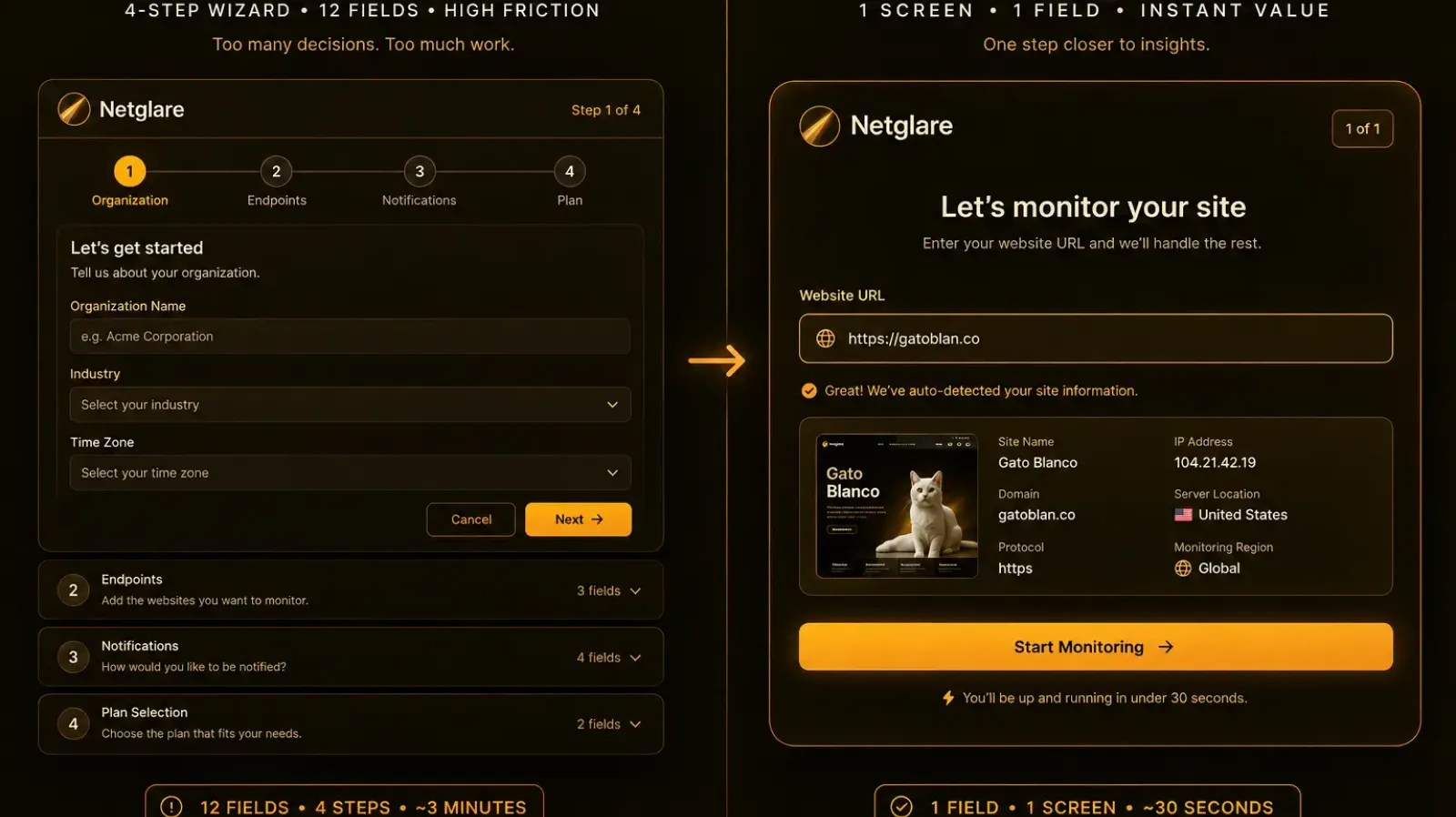
The old wizard asked four things before showing any value. Step one: organization name, industry and time zone. Step two: first endpoint URL, name and check interval. Step three: notification preferences including email, Slack and alert threshold. Step four: plan selection. Twelve form fields before a user sees a dashboard. Each step made sense in isolation. Collectively they were exhausting for someone who just wanted to see if the product was worth their time.
The structural problem ran deeper than the form fields though. Because the trial only started on wizard completion, abandoned signups had trial_ends_at set to NULL in the database. The commands that send trial warning emails and expire accounts filter on trial_ends_at IS NOT NULL, which meant wizard-incomplete users were permanently excluded from both. They accumulated silently as ghost accounts the business couldn't see, couldn't act on, and couldn't retain. Nine sprints of monitoring intelligence, incident grouping, threshold calibration, weekly digests, analytics dashboards, all of it invisible to anyone who left before completing step one.
The SaaS onboarding experience wasn't broken in an obvious way. It was broken in a structural way that only became visible when you looked at what happened to users who didn't complete it.
What Sprint 10 Actually Built
The wizard is now one screen. "What do you want to monitor?" with a single URL input field. Site name is auto-detected from the domain. Check interval defaults to five minutes. Timezone is detected from the browser. Notification defaults are saved silently. Plan selection happens later when the trial expires or the user visits billing. Everything removed from the wizard moved to Settings pages accessible from the dashboard. The information isn't gone, it's just no longer a prerequisite for getting value from the product.
The skip option is preserved: "I'll add one later" takes the user straight to the dashboard. But the psychological cost of skipping dropped from "skip step two of four" to "skip the only step," which feels meaningfully different. You're choosing to explore rather than abandoning a process.
The trial now starts at registration instead of wizard completion. Every registration enters the trial pipeline whether they finish onboarding or not. Abandoned signups now receive trial warnings, expire after fourteen days, and show up in admin dashboards as expiring trials. The business can see and act on every registration, not just the ones that made it through the wizard.
A three stage nudge sequence reaches users who register but don't add their first monitor. Twenty four hours after signup: "Your account is ready, add your first monitor." Seventy two hours: "Quick question, what are you monitoring?" with suggestions for common starting points and a list of what they'll get from their first endpoint. Seven days: "Your trial is halfway through," creating urgency without desperation. The sequence stops the moment someone adds their first endpoint. No further nudges after activation, no resurrecting ancient abandoned accounts.
What We Parked And Why
Domain scanning, the feature that would automatically discover subdomains and suggest endpoints when a user enters their company URL, is parked for post-launch. It's genuinely valuable and would make step one of the wizard smarter. But the wizard collapse already removed the biggest friction in the SaaS onboarding experience. Domain scan makes a working step smarter. Sprint 10 needed to make a broken sequence functional first.
The decision to park it was about sequencing, which is exactly what Sprint 10 is about. Fix the structural problem before adding sophistication on top of it.
What We're Watching
The GA4 funnel now tracks the exact pipeline: sign_up, email_verified, first_monitor_created. The key metric is time to activate, the minutes between registration and first endpoint. If Sprint 10 worked, that number drops and the conversion from signup to first monitor climbs. The nudge emails add a second signal: which stage converts? Is it the twenty four hour reminder, the seventy two hour feature pitch, or the seven day urgency email? That tells you whether the problem is awareness, value comprehension, or procrastination.
Nine sprints of monitoring intelligence. One sprint to make sure people actually get to experience it. The SaaS onboarding experience is fixed. The front door is open.
Head to netglare.com and try it yourself. The signup flow is genuinely different now. Or reach out at getstarted@gatoblan.co if you want to talk through your monitoring setup first.